• feature map的计算公式为outsize = (insize - fsize + 2*pad) / stride + 1
  • stride 的计算公式为totstride = totstride * stride,这两个公式都是从前往后算
  • receptive field RF = ((RF -1)* stride) + fsize,这个要从后往前算
1
2
3
4
5
6
7
8
9
10
11
12
13
14
15
16
17
18
19
20
21
22
23
24
25
26
27
28
29
30
31
32
33
34
35
36
37
38
39
40
41
#!/usr/bin/env python

net_struct = {'alexnet': {'net':[[11,4,0],[3,2,0],[5,1,2],[3,2,0],[3,1,1],[3,1,1],[3,1,1],[3,2,0]],
'name':['conv1','pool1','conv2','pool2','conv3','conv4','conv5','pool5']},
'vgg16': {'net':[[3,1,1],[3,1,1],[2,2,0],[3,1,1],[3,1,1],[2,2,0],[3,1,1],[3,1,1],[3,1,1],
[2,2,0],[3,1,1],[3,1,1],[3,1,1],[2,2,0],[3,1,1],[3,1,1],[3,1,1],[2,2,0]],
'name':['conv1_1','conv1_2','pool1','conv2_1','conv2_2','pool2','conv3_1','conv3_2',
'conv3_3', 'pool3','conv4_1','conv4_2','conv4_3','pool4','conv5_1','conv5_2','conv5_3','pool5']},
'zf-5':{'net': [[7,2,3],[3,2,1],[5,2,2],[3,2,1],[3,1,1],[3,1,1],[3,1,1]],
'name': ['conv1','pool1','conv2','pool2','conv3','conv4','conv5']}}

#[3,1,1] stands for filter_size, stride, padding

imsize = 224

def outFromIn(isz, net, layernum):
totstride = 1
insize = isz
for layer in range(layernum):
fsize, stride, pad = net[layer]
outsize = (insize - fsize + 2*pad) / stride + 1
insize = outsize
totstride = totstride * stride
return outsize, totstride

def inFromOut(net, layernum):
RF = 1
for layer in reversed(range(layernum)):
fsize, stride, pad = net[layer]
RF = ((RF -1)* stride) + fsize
return RF

if __name__ == '__main__':
print "layer output sizes given image = %dx%d" % (imsize, imsize)
for net in net_struct.keys():
print '************net structrue name is %s**************'% net
for i in range(len(net_struct[net]['net'])):
p = outFromIn(imsize,net_struct[net]['net'], i+1)
rf = inFromOut(net_struct[net]['net'], i+1)
print "Layer Name = %s, Output size = %3d, Stride = % 3d, RF size = %3d" % (net_struct[net]['name'][i], p[0], p[1], rf)

1
2
3
4
5
6
7
8
9
10
11
12
13
14
15
16
17
18
19
20
21
22
23
24
25
26
27
28
29
30
31
32
33
34
35
36
37
layer output sizes given image = 224x224
************net structrue name is vgg16**************
Layer Name = conv1_1, Output size = 224, Stride = 1, RF size = 3
Layer Name = conv1_2, Output size = 224, Stride = 1, RF size = 5
Layer Name = pool1, Output size = 112, Stride = 2, RF size = 6
Layer Name = conv2_1, Output size = 112, Stride = 2, RF size = 10
Layer Name = conv2_2, Output size = 112, Stride = 2, RF size = 14
Layer Name = pool2, Output size = 56, Stride = 4, RF size = 16
Layer Name = conv3_1, Output size = 56, Stride = 4, RF size = 24
Layer Name = conv3_2, Output size = 56, Stride = 4, RF size = 32
Layer Name = conv3_3, Output size = 56, Stride = 4, RF size = 40
Layer Name = pool3, Output size = 28, Stride = 8, RF size = 44
Layer Name = conv4_1, Output size = 28, Stride = 8, RF size = 60
Layer Name = conv4_2, Output size = 28, Stride = 8, RF size = 76
Layer Name = conv4_3, Output size = 28, Stride = 8, RF size = 92
Layer Name = pool4, Output size = 14, Stride = 16, RF size = 100
Layer Name = conv5_1, Output size = 14, Stride = 16, RF size = 132
Layer Name = conv5_2, Output size = 14, Stride = 16, RF size = 164
Layer Name = conv5_3, Output size = 14, Stride = 16, RF size = 196
Layer Name = pool5, Output size = 7, Stride = 32, RF size = 212
************net structrue name is zf-5**************
Layer Name = conv1, Output size = 112, Stride = 2, RF size = 7
Layer Name = pool1, Output size = 56, Stride = 4, RF size = 11
Layer Name = conv2, Output size = 28, Stride = 8, RF size = 27
Layer Name = pool2, Output size = 14, Stride = 16, RF size = 43
Layer Name = conv3, Output size = 14, Stride = 16, RF size = 75
Layer Name = conv4, Output size = 14, Stride = 16, RF size = 107
Layer Name = conv5, Output size = 14, Stride = 16, RF size = 139
************net structrue name is alexnet**************
Layer Name = conv1, Output size = 54, Stride = 4, RF size = 11
Layer Name = pool1, Output size = 26, Stride = 8, RF size = 19
Layer Name = conv2, Output size = 26, Stride = 8, RF size = 51
Layer Name = pool2, Output size = 12, Stride = 16, RF size = 67
Layer Name = conv3, Output size = 12, Stride = 16, RF size = 99
Layer Name = conv4, Output size = 12, Stride = 16, RF size = 131
Layer Name = conv5, Output size = 12, Stride = 16, RF size = 163
Layer Name = pool5, Output size = 5, Stride = 32, RF size = 195

v1

Atrous algorithm

  • deeplab和FCN一样,也是在VGG上finetune
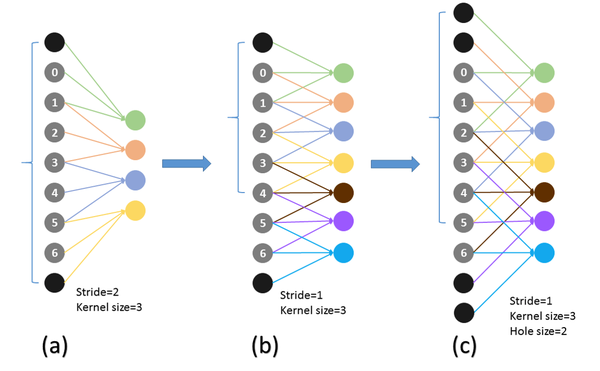
  • 首先要解决的问题是,如何增大最后输出的score map呢?deeplab把VGG最后的pool4和pool5的stride从2变成了1,整个VGG的stride从32变成8
  • 但是修改了stide之后,后面的conv层感受野就不一样大了,不能finetune了,所以这里引入了非常优雅的atrous algorithm
    • feature map的感受野的计算公式为$RF_{i}=(RF_{i+1}-1)*stride+kernel$
    • 所以在stride减小的情况下想办法增大kernel,即在kernel里面增加hole,kernel变大

deeplab

Fully connected CRF

  • CRF简单来说,能做到的就是在决定一个位置的像素值时(在这个paper里是label),会考虑周围邻居的像素值(label),这样能抹除一些噪音。但是通过CNN得到的feature map在一定程度上已经足够平滑了,所以short range的CRF没什么意义。于是作者采用了fully connected CRF,这样考虑的就是全局的信息了。
  • 随机变量$X_i$是像素$i$的标签,变量$X$由$X_1, X_2, …, X_N$组成随机向量,$N$就是图像中的像素个数。
  • 在全连接CRF中,标签$x$的能量为

$$
E(x)=\sum _i\theta_i(x_i)+\sum {ij}\theta{ij}(x_i,x_j)
$$

  • $\theta_i(x_i)$是一元能量,表示像素$i$被分割成$x_i$的能量,二元能量$\theta_{ij}(x_i,x_j)$像素点$i$、$j$同时分割成$x_i$、$x_j$的能量。
  • 一元能量使用FCN的输出

$$
\theta_i(x_i) = -logP(x_i)
$$

  • 二元能量表达式为

$$
\theta_{ij}(x_i, x_j)=\mu(x_i, x_j)[\omega_1exp(-\frac{\left |p_i-p_j \right |^2} {2\sigma_\alpha^2}-\frac{\left |I_i-I_j \right |^2}{2\sigma_\beta^2})+\omega_2exp(-\frac{\left |p_i-p_j \right |^2} {2\sigma_\gamma^2})]
$$

v2

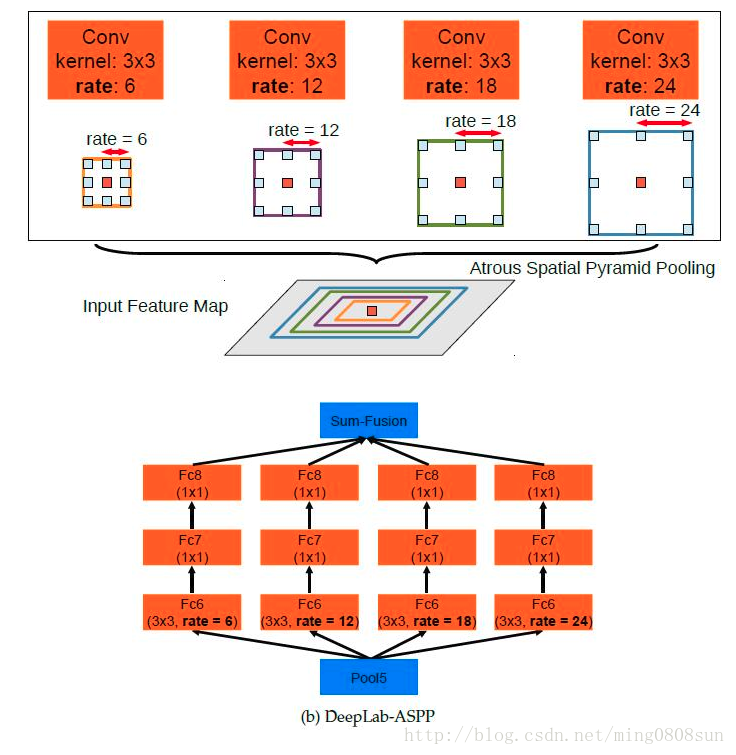
  • v2在v1的基础上增加了多感受野

deeplabv2

背景

  • 你需要把原来mtalab的代码翻译为c、python等等
  • 你的代码里使用了随机数
  • 你的老板又要求你实现的方法exactly the same
  • 参考这里

mt19927

  • Mersenne Twister是目前比较常用的随机数生成器
  • 周期非常长$2^{19937}-1$,速度非常快

python代码

1
2
3
4
5
6
7
import numpy as np
np.random.seed(1337)
A = np.random.random((5,3))
A.T
array([[ 0.26202468, 0.45931689, 0.26194293, 0.11527423, 0.12505793],
[ 0.15868397, 0.32100054, 0.97608528, 0.38627507, 0.98354861],
[ 0.27812652, 0.51839282, 0.73281455, 0.62850118, 0.44322487]])

MATLAB代码

1
2
3
4
5
6
7
8
9
10
11
12
13
14
15
rand('twister', 1337);
A = rand(3,5)
A =
Columns 1 through 2
0.262024675015582 0.459316887214567
0.158683972154466 0.321000540520167
0.278126519494360 0.518392820597537
Columns 3 through 4
0.261942925565145 0.115274226683149
0.976085284877434 0.386275068634359
0.732814552690482 0.628501179539712
Column 5
0.125057926335599
0.983548605143641
0.443224868645128

c++代码

1
2
3
4
5
6
7
8
9
10
#include <iostream>
#include <random>

int main()
{
unsigned seed1 = 1337;
std::mt19937 g1(seed1);
for(int i=0; i<100; i++)
std::cout << 1.0*g1()/g1.max() << std::endl;
}

还有一些

最简单的生成算法,混合同余法,可以看这里

c++11的random库,可以参考这里

coursera北大的c++课上的一道题,本地ok,poj(pku的OJ)上ok,垃圾coursera上compile error。
先贴在这里,我感觉写的还是很优雅的。

1
2
3
4
5
6
7
8
9
10
11
12
13
14
15
16
17
18
19
20
21
22
23
24
25
26
27
28
29
30
31
32
33
34
35
36
37
38
39
40
41
42
43
44
45
46
47
48
49
50
51
52
53
54
55
56
57
58
59
60
61
62
63
64
65
66
67
68
69
70
71
72
73
74
75
76
77
78
79
80
81
82
83
84
85
86
87
88
89
90
91
92
93
94
95
96
97
98
99
100
101
102
103
104
105
106
107
108
109
110
111
112
113
114
115
116
117
118
119
120
121
122
123
124
125
126
127
128
129
130
131
132
133
134
135
136
137
138
139
140
141
142
143
144
145
146
147
148
149
150
151
152
153
154
155
156
157
158
159
160
161
162
163
164
165
166
167
168
169
170
171
172
173
174
175
176
177
178
179
180
181
182
183
184
185
186
187
188
189
190
191
192
193
194
195
196
197
198
199
200
201
202
203
204
205
206
207
208
209
210
211
212
213
214
215
216
217
218
219
220
221
222
223
224
225
226
227
228
229
230
231
232
233
234
235
236
237
238
239
240
241
242
243
244
#include <iostream>  
#include <algorithm>
#include <string>
using namespace std;

class BigInt {
public:
BigInt(){
values = "0";
flag = true;
}
BigInt(const string stringvalue){
values = stringvalue;
flag = true;
}
BigInt(const int intvalue){
if (intvalue >= 0){
values = to_string(intvalue);
flag = true;
}
else{
values = to_string(-intvalue);
flag = false;
}
}
//~BigInt();
friend ostream& operator << (ostream& out, const BigInt& b);
friend istream& operator >> (istream& in, const BigInt& b);
BigInt& operator + (BigInt b);
BigInt& operator - (BigInt b);
BigInt& operator * (BigInt b);
BigInt& operator / (BigInt b);
bool operator >= (BigInt b);

//private:
string values;
bool flag;
};

bool BigInt::operator >= (BigInt b){
int agb = 0;
if (values.length() > b.values.length())
{
agb = 1;
}
else if (values.length() < b.values.length())
{
agb = -1;
}
else
{
agb = values.compare(b.values);
}
return agb>=0;
}

BigInt& BigInt :: operator + (BigInt b) {

if (flag == b.flag){
string res = "";
reverse(values.begin(), values.end());
reverse(b.values.begin(), b.values.end());
int i = 0, carry = 0;
for (; i < values.length() && i < b.values.length(); ++i){
int tmp = values[i] - '0' + b.values[i] - '0' + carry;
carry = tmp / 10;
tmp = tmp % 10;
res = (char)(tmp + '0') + res;
}
if (i < values.length()){
for (; i < values.length(); ++i){
int tmp = values[i] - '0' + carry;
carry = tmp / 10;
tmp = tmp % 10;
res = (char)(tmp + '0') + res;
}
}
else if (i < b.values.length()){
for (; i < b.values.length(); ++i){
int tmp = b.values[i] - '0' + carry;
carry = tmp / 10;
tmp = tmp % 10;
res = (char)(tmp + '0') + res;
}
}
if (carry == 1)
res = '1' + res;
values = res;
}
else{
int agb = 0;
if (values.length() > b.values.length())
{
agb = 1;
}
else if (values.length() < b.values.length())
{
agb = -1;
}
else
{
agb = values.compare(b.values);
}
if (0 == agb)
{
values = "0";
return *this;
}

else if (agb < 0){
flag = !flag;
string tmp = values;
values = b.values;
b.values = tmp;
}
string res = "";
reverse(values.begin(), values.end());
reverse(b.values.begin(), b.values.end());
int i = 0;
for (; i < values.length() && i < b.values.length(); ++i)
res.push_back(values.at(i) - b.values.at(i) + '0');

if (i < values.length())
for (; i < values.length(); ++i)
res.push_back(values.at(i));

int carry = 0;
for (i = 0; i < values.length(); ++i)
{
int newValue = res.at(i) - carry - '0';
if (newValue < 0) carry = 1;
else carry = 0;
res.at(i) = newValue + carry * 10 + '0';
}
while (res[res.length() - 1] == '0')
res.pop_back();
reverse(res.begin(), res.end());
values = res;
}

return *this;
}

BigInt &BigInt::operator - (BigInt b)
{
BigInt tmp(b);
tmp.flag = !tmp.flag;
return *this+tmp;
}

BigInt &BigInt::operator * (BigInt b)
{
BigInt res;
if (values == "0" || b.values == "0"){
values = "0";
return *this;
}
if (flag == b.flag)
flag = true;
else
flag = false;

BigInt thisbk(*this);
for (int i = 0; i < b.values.length(); ++i){
for (int j = 0; j < b.values[i] - '0'; ++j){
res = res + thisbk;
}
res.values.push_back('0');
}
res.values.pop_back();
values = res.values;
return *this;
}

BigInt &BigInt::operator / (BigInt b)
{
if (b.values == "0")
throw "Division by zero condition!";
if (flag == b.flag)
flag = true;
else
flag = false;

BigInt one(1);
while (*this >= b){
b.values.push_back('0');
one.values.push_back('0');
}
b.values.pop_back();
one.values.pop_back();

BigInt thisbk(*this), res(0);
while (one.values.compare("0") > 0){
while (*this >= b){
*this - b;
res + one;
}
b.values.pop_back();
one.values.pop_back();
}
values = res.values;
return *this;
}

ostream& operator << (ostream& ou, const BigInt& b)
{
if (!b.flag)
ou << '-';
ou << b.values;
return ou;
}

istream& operator >> (istream& in, BigInt& b)
{
string str;
in >> str;
b.values = str;
return in;
}

int main()
{
BigInt b1, b2;
string str;
cin >> b1 >> str >> b2;

if (str == "+")
{
cout << b1 + b2 << endl;
}
else if (str == "-")
{
cout << b1 - b2 << endl;
}
else if (str == "*")
{
cout << b1 * b2 << endl;
}
else
{
cout << b1 / b2 << endl;
}
return 0;
}

先说mobileNet

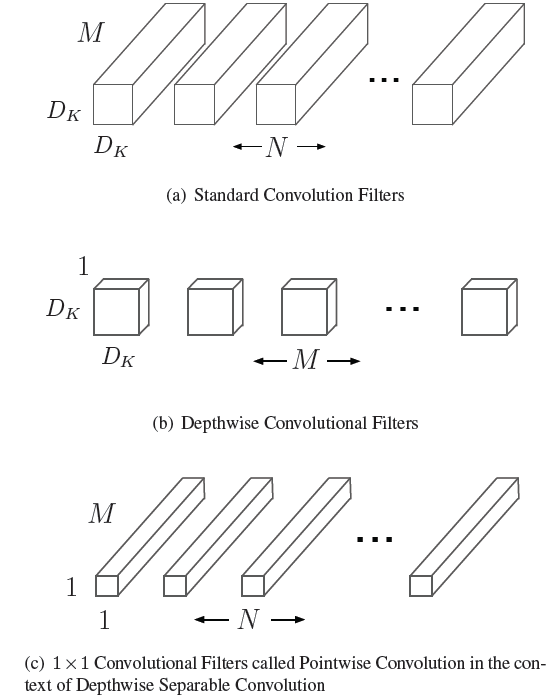
  • 使用depthwise convolution和point wise(1*1) convolution代替标准的convolution
  • (b)类似于group为M的卷积,m-th filter is applied to m-th channel
  • 计算量是原来的$\frac{1}{N}+\frac{1}{D_k^2}$,kernel一般是3,所以可以减少到1/8到1/9
  • 论文里还提出了两个控制计算量的超参数
  • width multiplier,$\alpha$,乘在channel前面,计算量减小到$\frac{1}{\alpha}$
  • resolution multiplier,$\beta$,乘在输入到尺寸前面,计算量减小到$\frac{1}{\beta}$
  • 好像文章里公式写错了,卷积到计算量应该是乘输出的尺寸,而不是输入到尺寸吧。。。

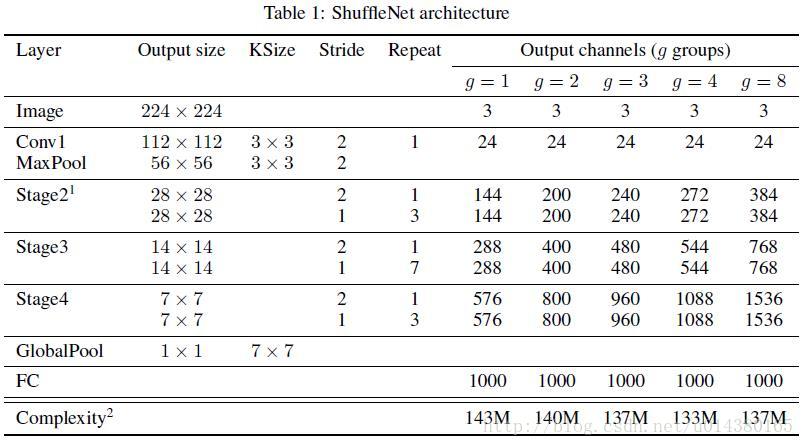
shuffleNet

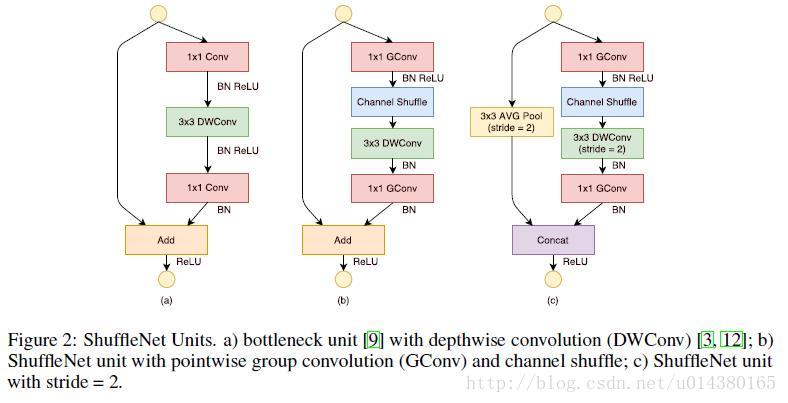
  • 在resnet的基础上,用带group的1*1卷积代替原来的1*1卷积
  • group操作会带来边界效应,学出来的特征会局限,所以就有了channel shuffle层
  • 随机层的caffe实现是先reshape再transpose再flatten,不是真随机,所以可以实现backward
  • 3*3的depth wise的卷积就是moblieNet里用到的
  • 然后用shuffleNet Unit组成shuffetNet网络
  • 一个重要结论是group个数的线性增长并不会带来分类准确率的线性增长。但是发现ShuffleNet对于小的网络效果更明显,因为一般小的网络的channel个数都不多,在限定计算资源的前提下,ShuffleNet可以使用更多的feature map。

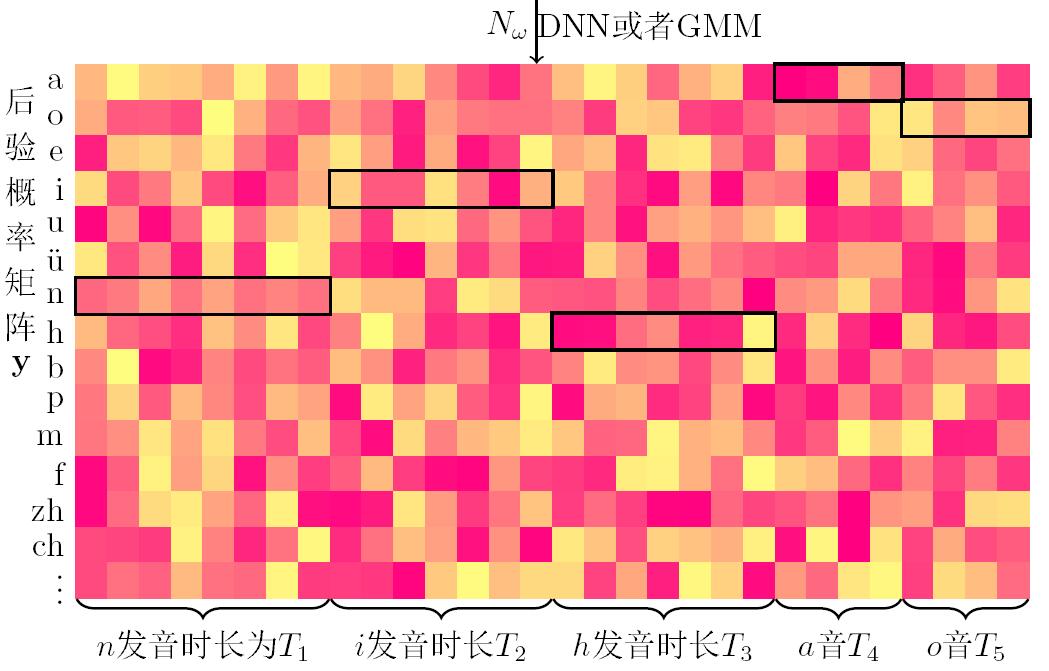
  • 以OCR为例,原始图片经过CNN卷积,图片高度方向尺寸变为1
  • 图片的宽度方向即为时间序列方向
  • 在channel分享进行innerproduct,然后softmax,得到每个序列在每个字符的概率,类似于下面这张图

  • 然后根据这个概率图,使用类似动态规划的思路,可以计算出ctc loss和导数

  • 不想写了,看下面这篇吧

  • CTC讲解

  • cin 带空格的字符串时,需要这样cin.getline(s, 80),s是char数组

  • 或者也可以这样getline(cin, str),原型为istream& getline (istream& is, string& str); ,C++对每种流都定义了一个getline函数

  • 在gcc编译器中,对标准库进行了扩展,加入了一个getline函数。会自动malloc, realloc,所以用的话,需要自己手动free,好像没啥人用,参考这里

  • cout 控制输出精度 cout << fixed << setprecision(2) << f#include <iomanip>

  • cout 控制输出格式cout << setfill('0') << setw(4) << a[i][j]

  • 更多

  • cin cout 重定向

    1
    2
    freopen("foo.txt","w",stdout); 
    freopen(“bar.txt”,”r”,stdin);
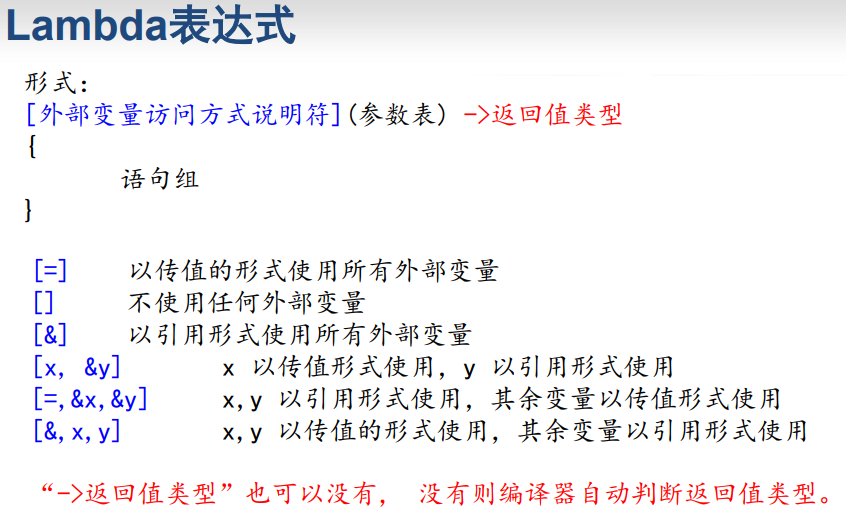
  • lambda表达式

  • 使用lambda对vector进行排序

    1
    2
    3
    4
    5
    6
    7
    8
    9
    10
    11
    12
    13
    14
    15
    16
    17
    18
    19
    20
    21
    22
    23
    24
    25
    26
    27
    28
    #include <iostream>
    #include <string>
    #include <vector>
    #include <algorithm>
    #include <cstdio>

    using namespace std;

    int main()
    {
    int n;
    double th;
    cin >> n >> th;
    vector<pair<string, double>> res;
    while(n--){
    string name;
    double score;
    cin >> name >> score;
    if(score > th){
    res.push_back(pair<string, double>(name, score));
    }
    }
    sort(res.begin(), res.end(), [](pair<string, double>& a, pair<string, double>& b) {return a.second > b.second;});
    for(auto i: res){
    printf("%s %.1f\n", i.first.c_str(), i.second);
    }
    return 0;
    }
  • erase删除vector元素

    1
    2
    3
    4
    5
    6
    for(it=iVec.begin();it!=iVec.end();){
      if(*it==4 || *it==5)
        it=iVec.erase(it);
      else
        it++;
    }
  • Sample a(0), Sample a = 0, 都是调用构造函数

  • Sample a(9); a = 8 调用两次构造函数,

  • Sample b = a , Sample b(a) 拷贝构造函数

  • 类型转换构造函数,编译系统会生成一个临时变量

  • C++编译器遵循以下优先顺序:

    先找参数完全匹配的普通函数(非由模板实例化而得的函数),再找参数完全匹配的模板函数,再找实参经过自动类型转换后能够匹配的普通函数,上面的都找不到, 则报错。

  • 优雅的内存对齐方法

    1
    2
    3
    4
    unsigned int calc_align(unsigned int n, unsigned align)
    {
    return ((n + align - 1) & (~(align - 1)));
    }
  • __declspec(dllexport)是导出声明,说明这个函数要从DLL中导出给别人用。

  • __declspec(dllimport)是说这个函数是从别处导入的,不适用也能正常编译代码。

  • ANSI C是美国国家标准局,为C语言制定的一套国际标准语法,避免各个厂家的C语言不一致

  • include的文件可以不写到gcc里面

1
2
#include "max.c"
gcc main.c
1
2
gcc -c max.c -o max.o
gcc max.o main.c

还是圣经旧约

  • 雅各回乡准备见以扫,但心存芥蒂,仆人和妻子在前,他在最后,且分成两队以备不测。
  • 当天晚上,朦胧之中有人找雅各摔跤,摔到天亮未分胜负,此人即是上帝,上帝让雅各改名以色列,与上帝摔跤的人。
  • 以扫和雅各相约同去以东(也不知道是哪里),雅各仍有戒心,让以扫先走,然后掉头去了迦南的示剑城。
  • 雅各女儿底拿被示剑城太子强奸,太子来提亲,雅各和儿子们要求示剑城全城男子割礼,太子同意,然后雅各儿子们趁他们蛋疼的时候,血洗示剑城。
  • 然后雅各带所有人回家见以撒,路上底拿难产而死,产下一子。
  • 雅各的一个儿子犹大扒灰的故事,太狗血不写。
  • 后面慢慢来吧

  1. 按属性选取var email = $('[name=email]');
  2. jQuery对象和DOM对象之间可以互相转化:
    1
    2
    3
    var div = $('#abc'); // jQuery对象
    var divDom = div.get(0); // 假设存在div,获取第1个DOM元素
    var another = $(divDom); // 重新把DOM包装为jQuery对象
  3. 过滤器
    1
    2
    3
    4
    5
    6
    7
    $('ul.lang li'); // 选出JavaScript、Python和Lua 3个节点

    $('ul.lang li:first-child'); // 仅选出JavaScript
    $('ul.lang li:last-child'); // 仅选出Lua
    $('ul.lang li:nth-child(2)'); // 选出第N个元素,N从1开始
    $('ul.lang li:nth-child(even)'); // 选出序号为偶数的元素
    $('ul.lang li:nth-child(odd)'); // 选出序号为奇数的元素
    css selector, element element是后代就可以,element>element必须是父子
  4. ajax jsonp
    1
    2
    3
    4
    5
    6
    7
    8
    9
    10
    11
    12
    13
    14
    15
    16
    17
    $.ajax({
    type: 'get',
    url: "http://api.money.126.net/data/feed/0000001,1399001",
    dataType: 'jsonp',
    success: function(data) {
    var str = '当前价格:' +
    data['0000001'].name + ': ' +
    data['0000001'].price + ';' +
    data['1399001'].name + ': ' +
    data['1399001'].price;
    alert(str);
    },
    error: function() {
    alert('出错了');
    }
    });

    jQuery的jqXHR对象类似一个Promise对象,我们可以用链式写法来处理各种回调
    1
    2
    3
    4
    5
    6
    7
    8
    9
    10
    11
    $.ajax({
    type: 'get',
    url: "http://api.money.126.net/data/feed/0000001,1399001",
    dataType: 'jsonp'
    }).done(function (data) {
    ajaxLog('成功, 收到的数据: ' + JSON.stringify(data));
    }).fail(function (xhr, status) {
    ajaxLog('失败: ' + xhr.status + ', 原因: ' + status);
    }).always(function () {
    ajaxLog('请求完成: 无论成功或失败都会调用');
    });

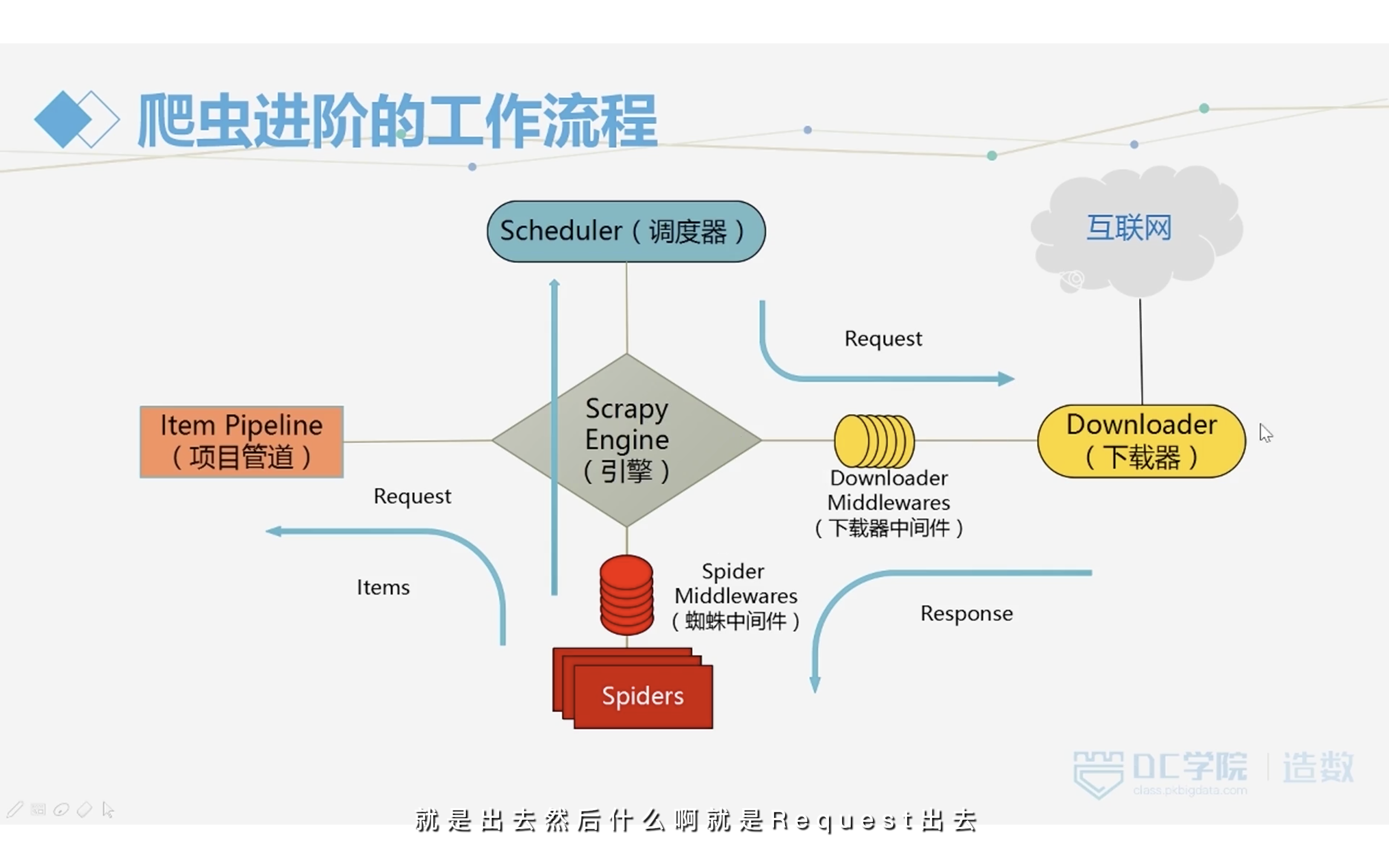
前言

这是在dc学院上299买的课,也是丧心病狂啊,怀着后悔的心情上完了全部课程。

主要截图

0%